Liberation Theology
Liberation Theology was first articulated in South America by Peruvian priest Gustavo Gutiérrez, who emphasized that faith must prioritize the poor, the exploited, and the oppressed. Since then, liberation theologies have emerged around the world, each applying this principle to different contexts of injustice. Examples include African American liberation theology in the Civil Rights Movement, Black liberation theology in South Africa within the Black Consciousness Movement, and feminist liberation theology as a response to global systems of patriarchy and marginalization.
The critical issue for every liberation theology, every liberation movement, is not simply to throw off oppression and empower the formerly victimized, but how to do so in a way that does not make former slaves into new slave masters.

The Birth of Palestinian Liberation Theology
Within this global movement, Palestinian Liberation Theology (PLT) was born when faith confronted the realities of land dispossession and the ongoing oppression of the Palestinian people.
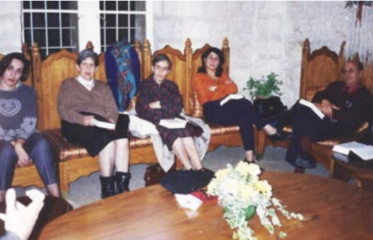
While its roots trace back to the Nakba (Arabic for “catastrophe”) of 1948, PLT began to take shape as a grassroots movement during the First Intifada. During this time, Rev. Naim Ateek, a Palestinian Anglican priest in Jerusalem, began hosting Bible reflection gatherings after Sunday worship. These sessions brought together Palestinian Christians from different denominations to explore scripture in light of their lived experiences under occupation.
Their reflections wrestled with pressing issues of the time—such as the fragmentation of the Palestinian Christian community, state violence, the rise of Christian Zionism, and the challenge of practicing nonviolence. It was in these gatherings that Palestinian Christians first began to read the Bible with Palestinian eyes, giving birth to the movement of Palestinian Liberation Theology.
The critical contribution of a Palestinian liberation theology is the struggle to answer this question. Only such a theology ‘can save us from repeating the cycle of violence, from empowering one oppressed people only by making them oppressors of another people.
-Rosemary Radford Reuther, late feminist theologian
Foundational Work - Justice and Only Justice
PLT was formally articulated in Rev. Naim Ateek’s landmark 1989 book, Justice and Only Justice: A Palestinian Theology of Liberation. This foundational text established Rev. Ateek as the father of Palestinian Liberation Theology and laid out its core principles: .
- Christ as a Palestinian Jew who lived under Roman Occupation: Rather than stressing the full divinity of Christ, Palestinian liberation theology emphasized Christ’s full human nature. In doing so, 20th century Palestinian Christians were able to connect with their 1st century ancestors and relate to Jesus in his relationship to the land, people, and empire.
- Centering Justice: Justice is the business of the church. Justice must be done first before peace and reconciliation can follow.
- Centering Inclusivity: In many theologies, such as Christian Zionism, the use of exodus and promised land motifs were used to displace Palestinians. Using a Christ-centered lens, PLT revealed that the nature of God is inclusive and that we must confront exclusive theologies that justify oppression.
- Nonviolence as our means: Palestinian liberation theology seeks to liberate ourselves not only from our oppressors but also from replicating systems of oppression. For this, PLT emphasized nonviolence as a revolutionary method that Jesus also practiced
As a member of this [PLT] movement, I could feel the internal pressure from the Christian faith, and the external pressure from world history...I feel in spite of the pressures, there is no way back into escapism or disengagement from the whole human family or of setting up dogmatic and religious walls in order to enjoy a separate Christian existence.
- Jean Zaru, Palestinian Quaker woman and Sabeel co-founder