About Sabeel
- Home
- About Sabeel
Sabeel Ecumenical Liberation Theology Center
Sabeel is an ecumenical grassroots liberation theology movement among Palestinian Christians. Inspired by the life and teaching of Jesus Christ, this liberation theology seeks to deepen the faith of Palestinian Christians, to promote unity among them and lead them to act for justice and peace.
Inclusivity
We recognize that every person is made in the image of God, making us all children of the Divine, regardless of identity or belief. Every life is sacred, and we reject racism and prejudice, allowing no justification or tolerance for such ideas.
Justice
Our faithfulness to God is shown in our role as a prophetic voice for justice and peace. We are committed to promoting restorative justice, defending human rights, and opposing all forms of injustice, especially genocide, apartheid, and occupation.
Nonviolence
We believe nonviolence is the only way to confront evil and respond with goodness. Sabeel promotes nonviolence as an ethical and truly effective approach, firmly rejecting all violence, which only leads to more loss and suffering.
Empowering Palestinian Communities
Discover Our Impact
Empowering communities, promoting justice, and fostering peace through grassroots initiatives and faith-based actions.
See Our ProgramsThe Founders
Meet Sabeel Founders
The founder of Sabeel established the movement to inspire Palestinian
Christians through the teachings of Jesus Christ, promoting faith, unity, and action for justice and peace.
Cedar Duaybis is a retired elementary school teacher. She spent the bigger part of her life supporting her husband’s ministry as an Anglican pastor in Israel and the West-Bank. She is a co-founder of Sabeel and the Secretary of its Board for 25 years. In her capacity at Sabeel, she also edited its books and spoke to visiting groups. She co-authored a number of books with Rev. Naim Ateek.
Elias Chacour was born on November 29, 1939, in the Palestinian village of Biram in upper Galilee, which was bulldozed by Israeli soldiers after the forced exile of his family in 1951. Chacour served as the Archbishop of Akko, Haifa, Nazareth and All Galilee of the Melkite Greek Catholic Church from 2006 to 2014. In 1965, Chacour came to the village of Ibillin in the Galilee as a young priest, where he saw the lack of educational opportunities for Arab youth beyond the 8th grade and created a school open to all local children regardless of religious affiliation. The Mar Elias Educational Institutions now has an enrollment of 2,750 students from age 3 through 18, including Muslims, Christians, and Druze. Chacour received the World Methodist Peace Prize in 1994 and the prestigious Niwano Peace Prize in May 2001. He is the author of the bestselling book Blood Brothers and We Belong to the Land.
Jean Mikhail Zaru is a Palestinian Quaker who was born in 1940 to a Quaker family in Ramallah, Palestine. Jean Zaru has been a prominent advocate for nonviolent resistance and a pioneer for women’s equality in the Palestinian community. She served as Presiding Clerk of the Ramallah Friends Meeting and was a founding member and vice-chair of Sabeel. She has also held leadership positions with the Jerusalem YWCA, serving as president, and as vice president of the World YWCA. In 2010, she was awarded the Anna Lindh Memorial Prize, which recognized her as “a beacon of hope” and acknowledged her advocacy for interfaith dialogue and her role as a lone female church leader in the Middle East. Zaru is the author of Occupied with Nonviolence: A Palestinian Woman Speaks. She was instrumental in establishing the Friends International Center in Ramallah, which works to nurture a Quaker presence, support the local community, and further peace and justice issues.
Jonathan Kuttab is a Christian Palestinian attorney, human rights activist, and co-founder of Al-Haq, Nonviolence International, and Sabeel. He served as the Head of the Legal Committee of the Palestinian delegation negotiating the Cairo Interim Agreement of 1994 between Israel and the Palestine Liberation Organization (PLO). He currently serves as executive director of Friends of Sabeel North America (FOSNA), leading efforts to advocate for justice and peace in the American context.
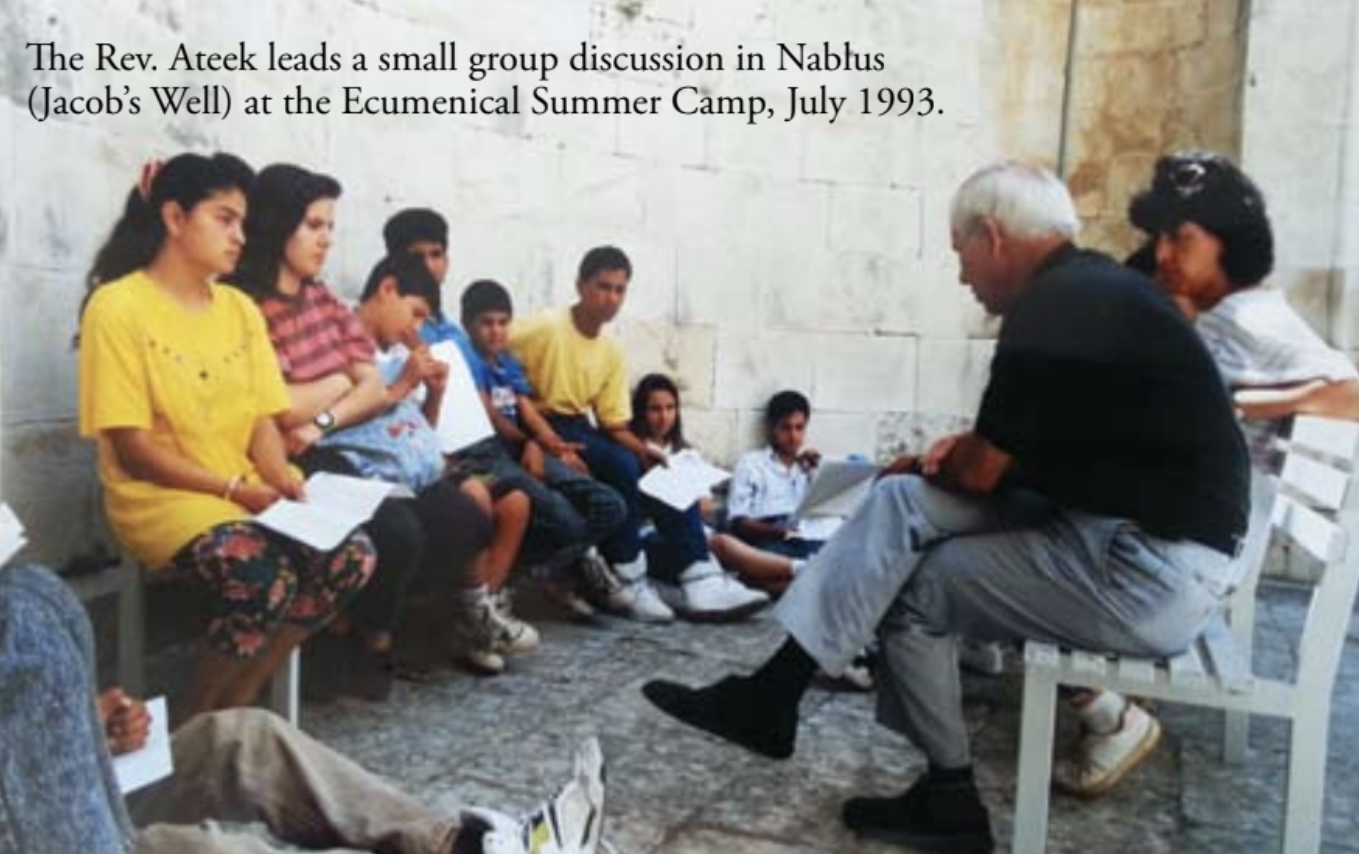
Rev. Dr. Naim Stifan Ateek was born in 1937 in the Palestinian village of Bisan, south of the Sea of Galilee. He and his family, along with the entire village were forced out of Bisan when the Israeli troops occupied Bisan in 1948. The family went to live in Nazareth. In 1967 he was ordained in the Episcopal Church. In 1991, Reverend Ateek co-founded Sabeel, the Ecumenical Liberation Theology Center in Jerusalem. Previous to that, he served as Canon of St. George’s Cathedral in Jerusalem and as parish priest in Haifa and Nazareth. He has been an active leader in the shaping of the Palestinian liberation theology. He was the first to articulate a Palestinian theology of liberation in his book, Justice and only Justice, published by Orbis in 1989, and based on his dissertation for his degree in theology. The book laid the foundation of a theology that addresses the conflict over Palestine and explores the political as well as the religious, biblical, and theological dimensions. A former Canon of St. George’s Cathedral, Jerusalem, he has authored and lectured on many books, booklets, and sermons widely both at home and abroad.
Riah Hanna Abu El-Assal is an Palestinian-Israeli Anglican bishop who was born in Nazareth on November 6, 1937. He served as the Bishop in Jerusalem from 1997 to 2007. His family fled to Beirut in 1948 during the creation of the State of Israel, and they returned to Nazareth in 1949. He gained Israeli citizenship in 1959 and graduated from Nazareth Baptist school, where he also taught. Bishop Riah has been deeply involved in both religious and political life. He was a member of the Progressive List for Peace (PLP), co-founded the Committee for the Defence of Arab Land, and helped organize the first Land Day strike on March 30, 1976. Throughout his career, he studied Islam extensively and has been committed to interfaith dialogue and peace efforts in the Middle East. He served as rector of Nazareth’s Christ Church, working as a pastor, community leader, and champion of Palestinian identity.
An active community volunteer, and a founding member of the Board of Trustees of Birzeit University, Samia Khoury served as national president of the YWCA of Jordan and of the YWCA of Palestine after it was affiliated to the World YWCA. She was president of Rawdat El-Zuhur and she served on the local advisory committee of the Mennonite Central Committee, She has earned recognition from local NGO’s and a citation of merit award from the alumni association of Southwestern University, in Georgetown , Texas from which she graduated with a BBA degree in 1954. Her book A Rhyme for Every Time: A Collection of verses for family and friends was published by Turbo and launched at Sabeel. Reflections from Palestine: A Journey of Hope was published by Rimal and launched at the International Sabeel Conference in Jericho in November 2013.